


Whether you need to plan your hair wash days in advance or simply enjoy the process, learning how to use shampoo and conditioner can turn your routine into something more enjoyable and effective part of your self-care.
Let’s explore the best techniques to help you get the most out of your shampoo and conditioner for the ultimate hair day every time—leaving your hair looking like you just stepped out of the salon.
Index
- How To Use Shampoo And Conditioner
- Difference Between Shampoo And Conditioner
- How Often To Shampoo And Condition Hair
- How Long Should You Leave Shampoo And Conditioner In Your Hair?
- Is It Better To Condition Hair Before Shampoo?
- Can You Use Shampoo And Conditioner At The Same Time?
- Is It Ok To Condition Your Hair Everyday?
- Should You Shampoo Everyday?
- Which Is The Best Conditioner For Hair?
- Which Is The Best Shampoo For Hair?
How To Use Shampoo And Conditioner

Shampoo and conditioner serve two different purposes and should be applied in specific ways depending on how often you wash your hair. Learning how to use shampoo and conditioner correctly can make a big difference in keeping your hair healthy and manageable. Here’s a step-by-step guide to wash your hair effectively and condition it for the best results:
- On wet hair, add preferred amount of shampoo into the palms of your hand.
- Rub your palms together to jump start the lather process and place your palms at your scalp.
- Massage your scalp ensuring you reach all areas of your head including the tricky places, i.e. your nape and the back crown area.
- Once you have lathered your entire scalp (only) rinse the shampoo.
TIP: if you experience a weak lather, repeat the above steps. - Once your strands have been rinsed from all signs of shampoo, step away from direct water contact and wring out excess water from your hair.
- Pour desired amount of conditioner into the palms of your hands and rub hands together.
- Now, grab your hair like a ponytail motion and apply conditioner on mid-strand through ends while avoiding direct application to the scalp.
- Work the conditioner through your strands by using your fingers to comb and separate your hair ensuring all your length has conditioner on them.
- Wait 1-3 minutes before rinsing with cooler temperature water.
Difference Between Shampoo And Conditioner
Understanding the difference between shampoo and conditioner is key to building an effective hair care routine. Each serves a unique purpose, targeting different needs to keep your hair healthy, clean, and hydrated.
Shampoo is created to cleanse away dirt, grime, product build up and unwanted excess oil from your scalp.
Shampoo will encapsulate all of the unwanted from your scalp and will rinse away residue as it rinses down your strands.
Due to the targeted cleansing power, it is best to shampoo at your scalp only and to avoid directly shampooing your ends.
Conditioner is made to quickly replenish moisture and hydration, as well as turning negative ions left behind by your shampoo into positive ions (this reduces static), while helping to detangle, reduce frizz and friction.
Conditioner will help balance your hair nutrients in places your scalp’s natural oils cannot reach which is why you will focus on the lengths of your hair -or mid-strands and ends.
How Often To Shampoo And Condition Hair

Finding the right balance between shampooing and conditioning can make a big difference in the health and appearance of your hair. Here’s what to consider:
While shampoo is great for removing excess buildup, oils, dirt, and grime, it doesn’t need to be used every time you wash your hair. In contrast, conditioner can be applied daily to restore hydration and moisture, especially if you focus on the mid-strands and ends.
If you allow your scalp's natural oils to develop, you might notice healthier, shinier hair. For this reason, it’s best to avoid shampooing every day and instead focus on conditioning to maintain your hair’s hydration.
Once you achieve the results you’re looking for, you can return to using shampoo and conditioner as a complementary pair to maintain balance.
How Long Should You Leave Shampoo And Conditioner In Your Hair?
Once you have a nice lather of shampoo all around your scalp it is recommended to indulge with at least a minute of a scalp massage before rinsing this out.
The reason for this is it allows the shampoo to melt to areas you may have missed around your scalp as well as invigorating blood circulation that may be beneficial to hair growth.
Your daily conditioner was created for quicker results when compared to a hair mask, but should still be kept on your hair for about three minutes before rinsing away with cooler temperature water.
Is It Better To Condition Hair Before Shampoo?
Depending on your hair type, conditioning hair before the shampoo may be beneficial for some.
The benefits of conditioning hair before shampooing may help deliver nutrients, help curb dehydration and may help detangle your hair prior to shampooing your scalp.
Remember, shampoo will still leave behind negative charged ions, so don’t skip the conditioner again after you have shampooed your strands.
Can You Use Shampoo And Conditioner At The Same Time?
You may use shampoo and conditioner back to back but ensure your shampoo is rinsed out prior to applying your conditioner if you are looking for the best results.
Due to the two separate jobs your shampoo and conditioner serve, you will want to avoid using them at exactly the same time.
Is It Ok To Condition Your Hair Everyday?

If your hair has a natural texture, is experiencing severe dehydration, or is on a routine to mend damage, it is okay to condition your hair length everyday.
Your scalp's job is to create and regulate natural oils so you will want to avoid applying conditioner directly on your scalp so that you do not disrupt this natural process.
However, focusing on your mid-strands and ends you may see the results you are looking for by conditioning everyday.
What Happens If Conditioner Is Applied To The Scalp?
Conditioner on the scalp is one of the most common reasons hair looks flat and greasy a few hours after washing. Your scalp is skin and your ends are hair fiber, so they need different products.
Apply conditioner from the mid-strands through the ends. Our full guide explains whether you should put conditioner on your scalp and where to apply it instead.
Can I Use Conditioner Without Shampoo?

Conditioner cleansing will not free your hair of the unwanted grime and oil build-up and may lead to dirty looking hair.
While there are some conditioning shampoos on the market they still have a job to cleanse the hair, though it may be the most gentle cleanser it will still cleanse to some degree.
Not all conditioners are made this way so it is best to research the correct conditioning shampoo that was formulated to provide that experience for you.
Does Conditioner Cause Hair Loss?
No, conditioner will not cause direct hair loss because conditioner is made to spot treat your mid-strands and your ends, and hair loss is determined underneath the scalp at your follicle.
Conditioner is designed for the mid-strands and ends, not the scalp, so keeping it off the roots is really about how your hair looks and feels rather than about hair loss. If shedding is your concern, our guide on hair shedding vs. hair loss explains the difference.
Should You Shampoo Everyday?

For most people, no.
How often you should shampoo depends on your scalp, your hair type, and your lifestyle. Someone with fine, straight hair and an oily scalp will need to wash more often than someone with thick, curly, color-treated hair. Every other day is where most people land, but there is no single correct number.
What matters more than frequency is what you are washing with. A harsh cleanser can leave your scalp feeling tight and your ends feeling dry and rough, which is what sends people back to the shower sooner than they need to go. A gentle, sulfate-free shampoo cleans the scalp without that stripped feeling.
One thing worth clearing up, because it gets repeated everywhere: washing your hair less often will not train your scalp to produce less oil. That idea is not well supported. What actually helps is finding a rhythm your scalp is comfortable with and staying consistent, rather than swinging between over-washing and stretching too far between washes.
If your scalp feels persistently oily, the more likely culprits are product buildup, hard water, or conditioner sitting too close to the roots. Our guide to oily hair walks through the real causes and what to do about them.
What Happens If You Don’t Wash All The Shampoo Out Of Your Hair?

If you do not rinse all of the shampoo out of your hair you may experience dandruff, dry, itchy scalp and some areas on your head may still look dirty and or oily.
It is important you rinse away all of your shampoo to avoid a complete style out only to find yourself having to jump back in the shower to start over again.
How Do I Know If My Shampoo Is Still In My Hair?
Leftover shampoo can affect your hair's texture, scalp health, and styling results. Here are some signs to watch out for:
- You may hear the suds in some places on your scalp
- Your hair feels more dry than it did prior to your shampoo and conditioner
- Hair feels oily or dirty in spots along the scalp
- You cannot reach your desired volume or overall body in your finished style
- It takes a long time to dry your hair
- Dandruff looking flakes are developing on your scalp or throughout your hair strands
Should You Shampoo Twice?
If you wait long in-between shampooing or just came home from a weekend of glam, it is a good choice to shampoo your hair twice.
This allows for the shampoo to get evenly distributed around your scalp.
Rule of thumb is, if the first shampoo isn’t giving you much of a natural lather, rinse and shampoo twice.
Which Is The Best Conditioner For Hair?

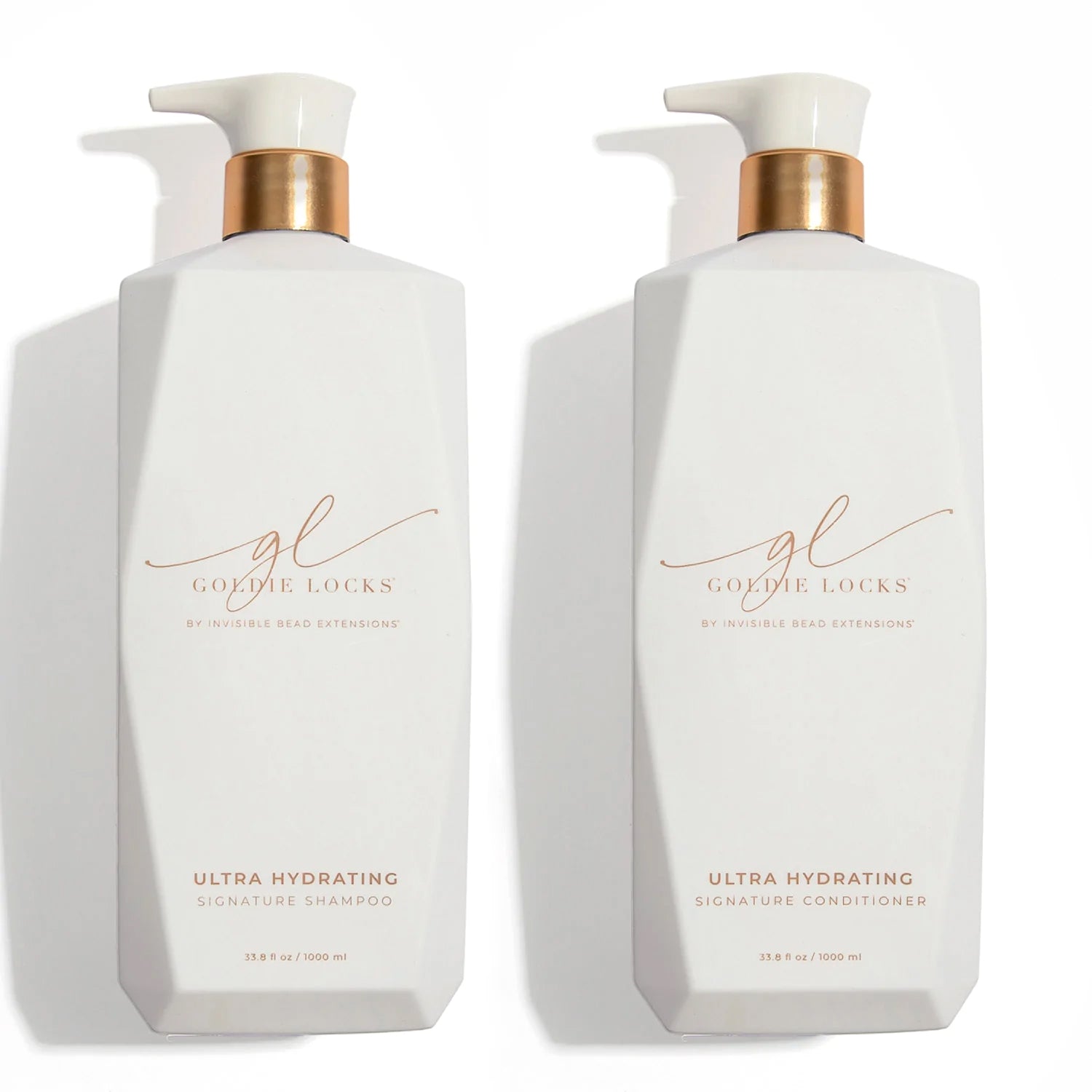
Goldie Locks® Signature Conditioner is the best conditioner for all hair types and textures, especially for those who wear extensions or have color-treated or highlighted their natural hair.
Due to the expansive list of naturally hydrating ingredients, it will replenish needed nutrients while rebalancing hydration and moisture.
Your hair's overall strength is mostly hydrogen and salt, which Goldie Locks® conditioner targets to add to your strands, making this a great choice for any person. In addition to that, the types of ingredients used to deposit the hydration and moisture is not fatty so it works by penetrating the hair rather than weighing hair down and sitting on top.
For those that are feeling dry, rough, dull, or easily tangled hair will surely be amazed at the rejuvenation benefits Goldie Locks® Signature Conditioner will bring to your strands, including those with weak or splitting ends!

Which Is The Best Shampoo For Hair?

Goldie Locks® Signature Shampoo is a laser focused shampoo that is not only gentle, but it’s powerful enough to cleanses unwanted oil, grime and build-up while leaving behind essential nutrients your hair needs to stay healthy.
It's the unique signature complex of natural ingredients and the sulfate-free cleanse that acts as a magnet to attract grime and rinses away without a trace of harsh chemicals that would otherwise leave hair feeling dry and depleted.
In addition to this, Goldie Locks® Signature Shampoo is vegan and free of sulfates, parabens, gluten, dmdmh and phthalates, so it will protect your color, the overall integrity of your natural hair texture and is the only recommended shampoo for hair extensions.